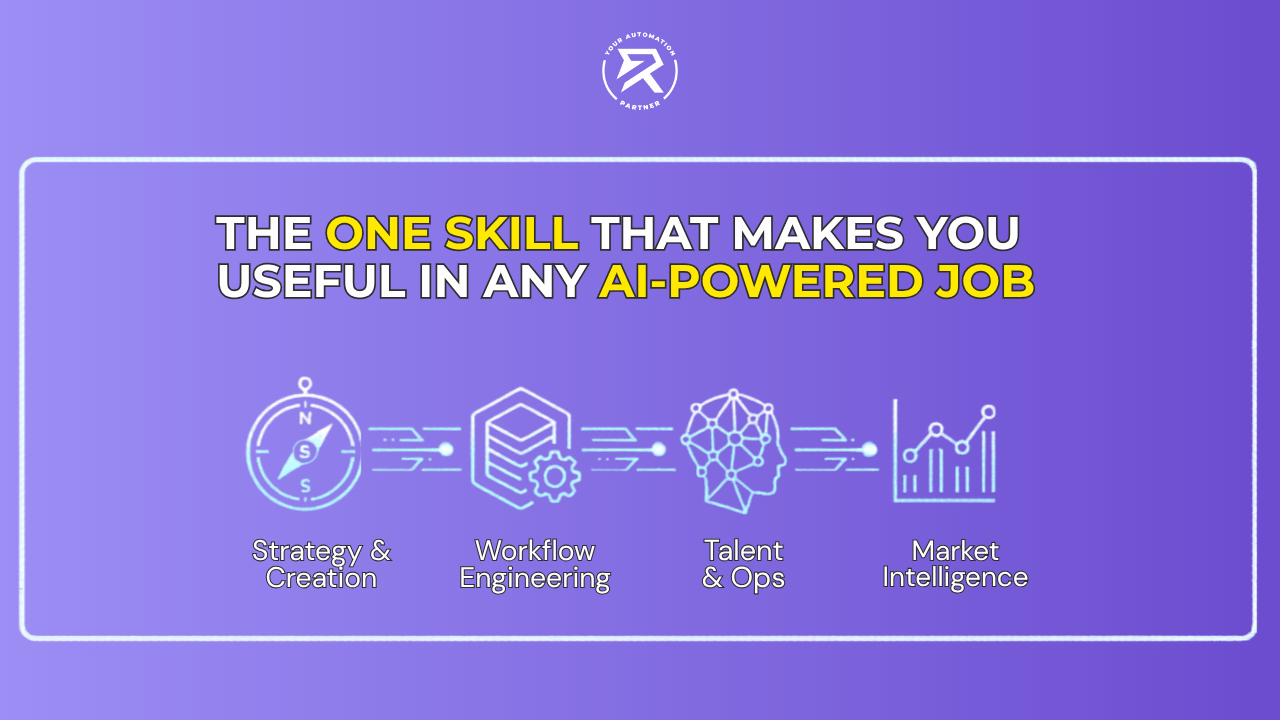
Don’t Just Read About AI - 🤫Secretly Implement It.
The secret to doing 10 hours of business work in 10 mins? Master AI & automation basics in just 3 hours. Apply to ANY field! 🚀
Save My Spot 🙋♂️/🙋♀️Key Takeaways:
- The skill is not "knowing AI tools" — it is knowing what to hand to AI and what to keep for yourself
- Every job title will change. The underlying skill that survives every change is workflow thinking
- You do not need to be a developer, data scientist, or prompt engineer
- This skill takes few hours to learn the basics — and compounds every week after that
- Anyone who can break a task into steps and connect tools together will be indispensable in the next 5 years
What Everyone Gets Wrong About AI Skills
Most people think the skill you need for an AI-powered job is "knowing how to use ChatGPT" or "learning prompt engineering". So they watch a few YouTube videos, play around with some tools, and move on.
That is not the skill. That is just using a tool.
The AI skills that actually matter at work are not about chatting with a model. They are about understanding automation logic — knowing how a task flows from trigger to result, which parts can be handed off to artificial intelligence, and how to connect everything so it runs without you watching it. That is what separates someone who uses AI occasionally from someone who builds systems that work while they sleep.
Here is the honest reality: most businesses are not looking for someone who can write a clever prompt. They are looking for someone who can look at a broken, manual process — a sales team copying leads from a spreadsheet, a marketing team spending three hours scheduling social posts, or an operations person manually sending invoice reminders — and say, 'I know how to automate that.'
That person is immediately valuable. In any company. In any role. In any industry. And in a labour market being reshaped by generative AI, that person is also increasingly hard to find — which is exactly why the talent shortage for people who can actually implement AI at work is growing every year.
If you are not sure whether this applies to you, read Who Should Learn n8n Automation? — it answers that question directly.
Workflow Thinking: The Skill Behind Every Useful AI Job
Workflow thinking is the ability to look at any repeating task and describe it as a sequence of steps, each with an input and an output — and then ask, 'Which of these steps can a machine do?'
It sounds simple. Most people have never done it consciously.
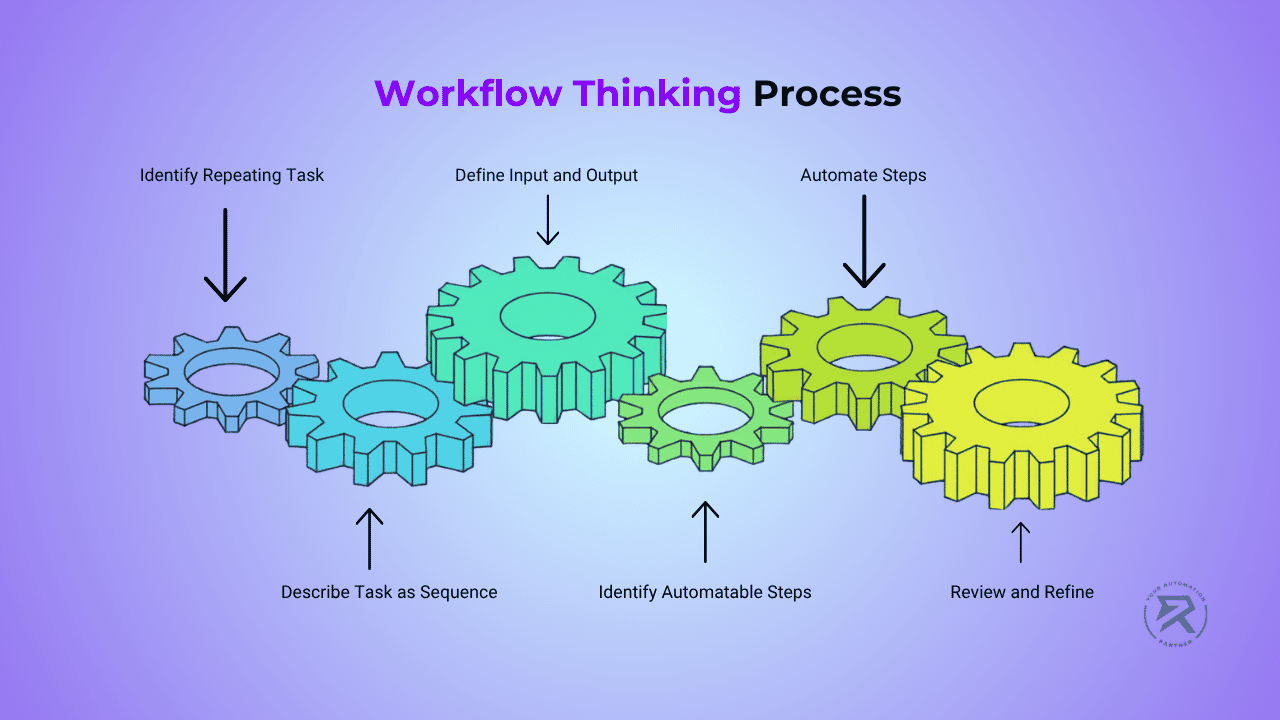
Here is an example. A marketing manager at a mid-size company spends 90 minutes every Monday morning doing this:
- Open Google Sheets. Copy last week's blog posts.
- Open ChatGPT. Write social captions for each post.
- Open Buffer. Schedule each caption.
- Send a Slack message to the team: "This week's posts are scheduled."
She has been doing this for 18 months. Every Monday. 90 minutes each time.
A person with workflow thinking looks at that and sees four steps – three of which can be automated completely. The only step that genuinely needs a human is maybe a 5-minute review to catch anything odd before it goes out.
That is it. That is the skill. Seeing the steps. Knowing which ones to automate. Building the connection.
New to the idea of automation entirely? Start with What is n8n: A Beginner's Guide to Automation before coming back here.
Why Workflow Thinking Works Across Every Role and Industry
Here is a quick look at how this plays out across different job roles:
| Role | What changes with AI | What the workflow thinker does |
| Marketing | Generative AI writes copy, generates images | Builds the pipeline that briefs AI, reviews output, and publishes it. |
| Sales | AI qualifies leads and drafts emails | Automates lead scoring, email sequences, and CRM updates |
| HR | AI screens resumes | Builds the system that ingests CVs, runs scoring, and flags top candidates |
| Finance | AI flags anomalies in data | Connects the monitoring workflow to send alerts before humans notice |
| Customer service | AI assistants handle FAQs | Designs the routing logic so complex queries reach humans faster |
In every case, the AI does not replace the person. It replaces the repetitive part of the person's job. The person who understands how to build and manage that handoff becomes more valuable, not less.
This is the real meaning of AI at work — not replacing human judgement, but augmenting it. The human-machine partnership works best when someone has designed the handoff deliberately. That is exactly why learning no-code is now essential for entrepreneurs — and increasingly for employees at every level too. The AI automation trends shaping 2026 point in one direction: the people who can connect tools together are the ones companies are fighting to hire.
AI literacy — knowing not just what AI can do but how to put it to work inside a real process — is fast becoming the baseline expectation across career paths in business, operations, and technology.
What This Skill Is Not
It is worth being clear about what you do not need.
You do not need to code. No-code automation platforms like n8n, Make, and Zapier let you build complex automation visually – drag, drop, and connect. No terminal, no Python, no debugging at 2 am. There are also excellent no-code tools for rapid prototyping if you want to test an idea before committing to a full build.
You do not need a background in machine learning, deep learning, or neural networks. You do not need to understand how a large language model is trained, how natural language processing works under the hood, or what a transformer architecture looks like. Those are skills for AI engineers and ML engineers building the models — not for people using them inside business workflows. You just need to know what to send the model and what to do with the response.
You do not need to be a data scientist or software engineer. Some of the best workflow builders we have seen at Ritz7 came from operations, marketing, and even law. The skill is closer to project management thinking than it is to engineering. Small businesses automate successfully every day — without a single developer on the team.
What you do need is a willingness to look at your own work — or your team's work — and ask: What here is repetitive? What follows the same pattern every time? What would take me 10 seconds to explain to an intern? Those are the tasks that can be automated.
Clearing Up the Confusion: What You Need to Know
When we talk about shifting from basic tool usage to systemic design, a few critical questions always come up. Let's clear up exactly where the line is drawn.
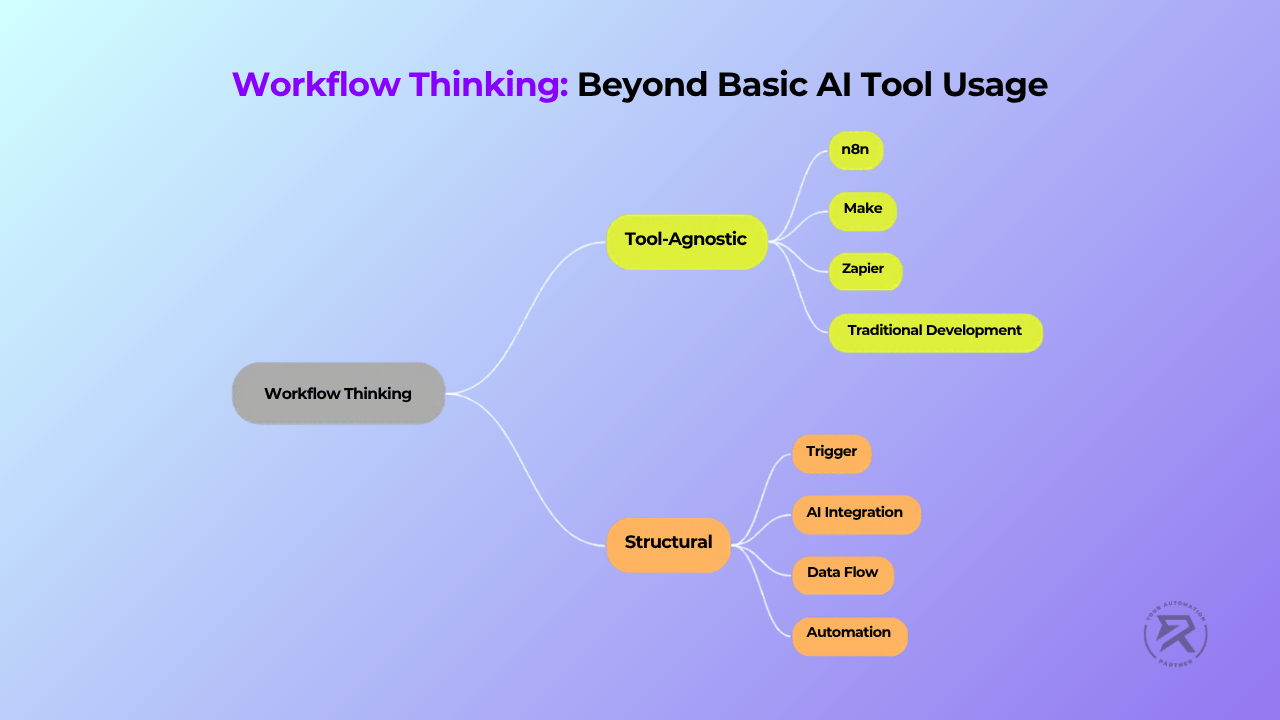
Is this skill just about n8n, or does it apply to other tools?
The underlying skill is completely tool-agnostic. While n8n is an incredible, visual, and cost-effective platform to learn on, workflow thinking applies universally across the entire automation ecosystem. Whether you build visually using no-code automation platforms like Make and Zapier, or deploy custom code via traditional development, the core logic remains exactly the same. The platform you choose is just the vehicle; workflow thinking is knowing how to drive.
What is the difference between workflow thinking and just using AI tools?
Using basic generative AI tools is transactional. You type a prompt, get an answer, copy-paste the result, and move on. It requires your manual intervention every single time.
Workflow thinking is structural. Instead of treating AI as an isolated chat box, you treat it as a single cog inside a larger, automated engine. You design an end-to-end system where a trigger automatically passes data to the AI, and the AI automatically hands the output to the next tool. The first approach relies on your constant time and effort; the second approach scales endlessly while you sleep.
What AI skills will employers actually pay for?
The AI jobs seeing the highest growth right now—whether you are aiming for a specialised role or looking to become indispensable in operations, marketing, or finance—all share one non-negotiable requirement: the ability to implement generative AI at work inside real business processes.
According to major workforce skills surveys from LinkedIn Learning and Microsoft, the biggest talent shortage isn't people who know how to use ChatGPT. The critical skills gap employers are actively fighting to close is AI aptitude—specifically, finding professionals who can look at a broken, manual business process and build an autonomous, production-ready workflow to fix it.
What Workflow Thinking Looks Like in Real Life
The best way to understand this skill is to see it applied to real tasks. Here are some examples of what it produces — each one started with someone asking: Can I automate this?
- Email handling: Instead of reading every form submission and replying manually, you build a flow that automates email replies from form submissions — categorised, personalised, and sent without you touching it.
- Content creation: Instead of writing YouTube metadata by hand for every video, you build a YouTube video summariser in n8n that generates titles, descriptions, and chapters automatically.
- Client scheduling: Instead of going back and forth over calendar slots, you automate scheduling with ElevenLabs and n8n so the whole booking process runs itself.
- WhatsApp communication: Instead of manually messaging leads or customers, you build a WhatsApp AI agent with n8n that handles common questions and routes complex ones to a human.
- Meeting follow-ups: Tools like Grain AI can automate meetings, sales notes, and learning — so nothing falls through the cracks after a call.
- Newsletter production: Instead of assembling each issue by hand, you build an automated AI newsletter that curates, drafts, and delivers content on a schedule.
None of these required a developer. Each one started with someone mapping the steps, then building the connections.
These are the kinds of workflows generative AI tools make possible today — not as experiments, but as production systems running inside real businesses.
How the Skill Compounds Over Time
The reason this skill is worth learning right now — not next year, not after the "AI hype" settles down — is that it compounds.
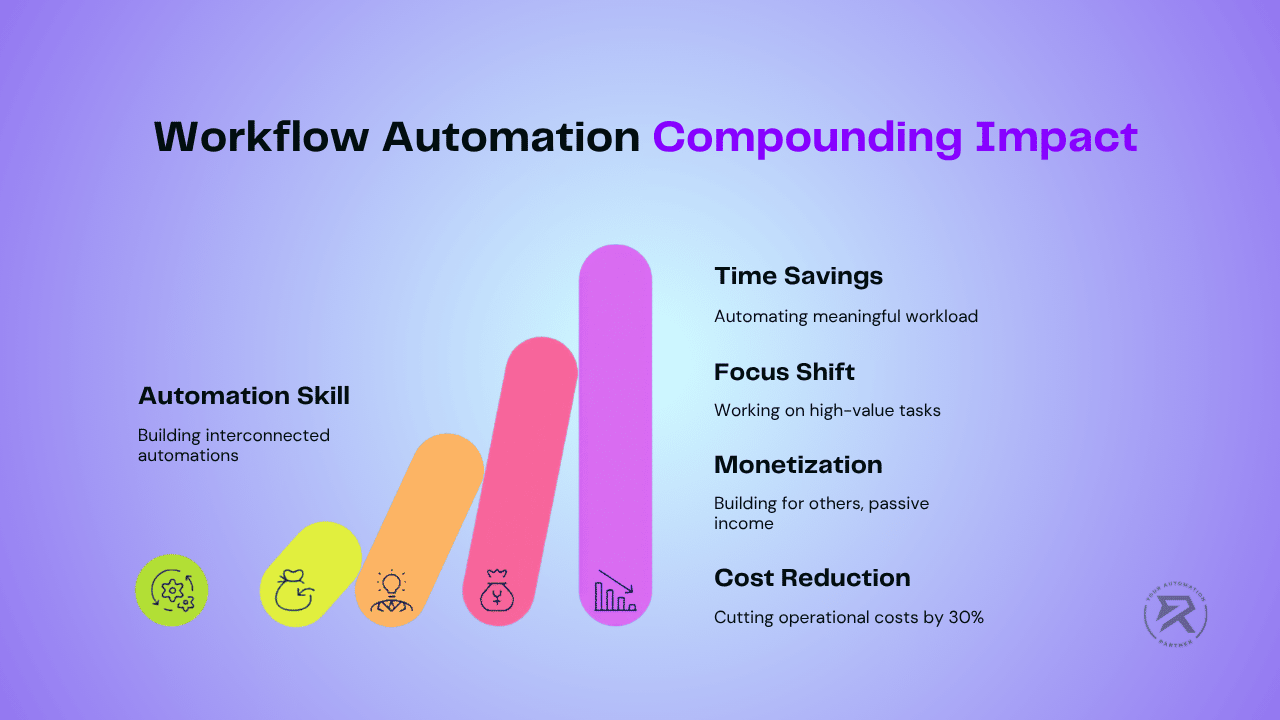
The first workflow you build might save you 2 hours a week. The second one, because you now understand the patterns, takes half the time to build. The third one connects to the second. By month six, you have a system of interconnected automations that handles a meaningful chunk of your workload — and you spend your time on the work only you can do.
We have seen this at Ritz7. Our team uses n8n to auto-generate YouTube titles and descriptions, produce first drafts of blog posts, and handle content tasks that used to eat hours every week. Those workflows took time to build. Now they run quietly. The output — YouTube metadata, blog drafts, social content — flows in automatically. Our team focuses on the judgement calls: is this good? Does this reflect our voice? What story should we tell next?
That is the version of AI at work that actually feels good. Not scrambling to keep up with tools. Not copy-pasting into ChatGPT 40 times a day. A system you built, running in the background, doing the heavy lifting while you do the thinking.
Once you have the skill, you can also monetise your n8n automation skills – building things for others, selling templates, or generating passive income with n8n workflows that earn while you sleep. But even if you never sell a workflow, the skill pays dividends across every career path you take.
The data backs this up too — companies that invest in business process automation cut operational costs by 30%, and the people who drive that change become indispensable. The business impact of being the person who can implement AI rather than just talk about it is not subtle — it shows up in promotions, client wins, and job security.
How to Start Building This Skill Today
There is no shortcut to building intuition — you have to build something real. But the fastest path is this:
Step 1: Pick one task you repeat every week. Not a big project. A small, boring, repetitive task. Something you could explain to someone in 60 seconds.
Example: Every Friday you copy your team's status updates from Slack into a Google Sheet to track progress. That is a perfect first automation.
Step 2: Write out every step. Literally write it down. Input → action → output for each step. Do not skip this. Once you can see how work flows, automating recurring steps becomes obvious — but you cannot see it until you have drawn it out. A simple list or whiteboard sketch is enough. No special tools, no jargon.
Example: (1) open Slack, (2) find the updates channel, (3) copy each message, (4) paste it into the sheet, and (5) add the date. Steps 3 and 4 are the ones to automate.
Step 3: Build it with a no-code tool. n8n is the best starting point — it's free to self-host, connects to almost everything, and the visual interface makes the logic clear as you build. Start with the n8n tutorial: create an OpenAI assistant to see exactly how AI plugs into a live workflow.
Example: a Slack node reads the channel, and a Google Sheets node writes each message as a new row – built in under an hour.
Step 4: Run it. Break it. Fix it. The first run will almost never be perfect. That is fine. The debugging is where you learn the most. If you are building agentic AI workflows or autonomous AI agents specifically, read Stop Deploying Broken Agents: The Production Guide before you go live.
Example: The workflow pulls too many messages — add a filter for the last 7 days. One fix, done.
Step 5: Add one more step. Once the simple version works, extend it. Add an AI step. Make it smarter.
Example: Add an OpenAI node between Slack and Sheets — instead of raw messages, the workflow now writes a clean 3-line summary for each update. Your manager loves it. You built it in 20 minutes.
You might also explore mastering MCP on OpenAI Agent Builder or building a Telegram calendar bot as your next step.
Three to four hours is all it takes to go from zero to a working automation that saves you real time. We keep it simple by focusing on the core basics—triggers and actions. If you want to see it in practice, join our live workshop.
The Honest Picture: This Is Not Magic
Workflow thinking will not save a bad business. It will not replace judgement, taste, relationships, or leadership. It will not turn a weak product into a strong one.
What it will do is remove the friction between your good ideas and their execution. It will give you back hours every week that you can put into the work that actually matters. And in a labour market where AI is reshaping every job role, it will make you the person who understands how the new tools fit together — not the person who is waiting to find out.
The workforce skills gap is real. According to LinkedIn Learning and Microsoft's Work Trend Index, AI aptitude — the ability to work effectively alongside artificial intelligence — is now one of the fastest-rising requirements across every industry. AI power users, the people who build systems rather than just use tools, are outperforming peers at every level. The gap between those who have this skill and those who do not is widening every quarter.
The future of automation is already transforming businesses — and the shift is accelerating. The people who thrive are not the ones who know the most tools. They are the ones who can look at any process, understand its structure, and make it run better.
That is a learnable skill. You can start today.
At Ritz7, we help businesses and individuals build real automation systems using n8n and AI. Browse the full blog for hands-on guides, or join the Ritz7 Automations community to share what you are building and find your first clients.